One Year, Real Skills: What a $350 Art Budget Actually Gets You
Every art supply store, online course platform, and YouTube channel wants you to believe that the right purchase will unlock your creative potential. Buy the professional-grade brushes. Subscribe to the masterclass. Upgrade to the tablet with tilt sensitivity.
But what does skill development actually look like when you strip away the marketing noise and just... do the work? We wanted to find out. So we followed one beginner artist — Diane Castellano, a 34-year-old office manager from Columbus, Ohio, with zero formal training — for twelve months. Her budget: $350 total. Her time commitment: about an hour a day, most days.
Here's what we learned.
Month One: The Humbling Phase
Diane started with pencil drawing. Specifically, she committed to filling one sketchbook page every day for the first month, no matter what came out. The early work was, by her own description, "genuinely bad in an embarrassing way."
But here's the thing about genuinely bad early work: it's a baseline. Those first thirty pages became a reference point that would prove invaluable later. She photographed every page.
Her month-one budget: $23. A sketchbook, a set of graphite pencils in varying grades, and a kneaded eraser. That's it.
What she practiced: basic proportion, contour drawing, and learning to actually look at objects instead of drawing her idea of them. She used free YouTube tutorials from channels like Proko and Ctrl+Paint, both of which offer genuinely professional-level instruction at no cost.
The Six-Month Checkpoint
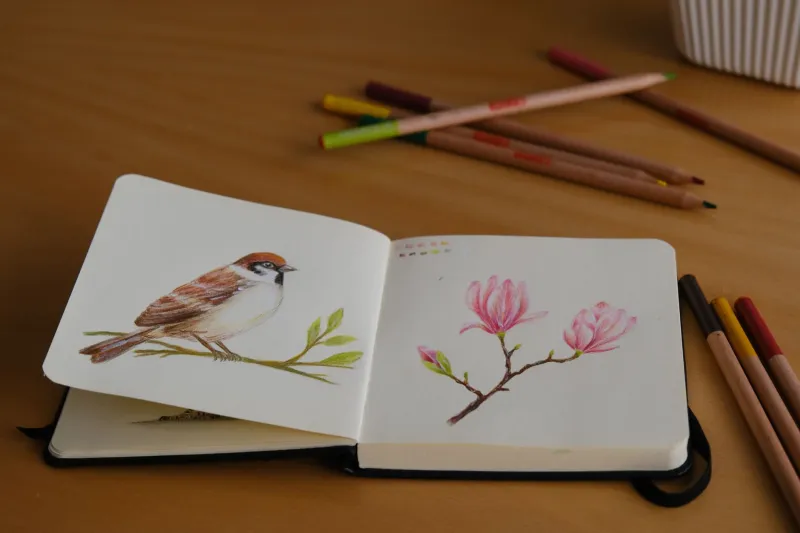
By month six, something had shifted. The change wasn't dramatic in any single drawing — it was cumulative. Looking at her month-one work next to her month-six work, the difference was clear: her lines were more confident, her proportions more accurate, and she'd developed a sense of when something was "off" and the vocabulary to understand why.
She'd also branched into watercolor at month three, spending $47 on a student-grade pan set and a few brushes. Watercolor humbled her all over again, which she says was actually useful. "It reset my expectations. I thought I was getting good at drawing, and then I picked up a new medium and felt like a beginner again. But I got better faster the second time because I understood the learning curve."
This is a documented phenomenon in skill acquisition research: learning a second skill in a related domain often accelerates faster than the first because your brain has already built some of the underlying frameworks.
What Actually Moved the Needle
After twelve months, we asked Diane to reflect on what made the biggest difference. Her answers didn't line up with what the art supply industry would prefer you to believe.
Daily practice beat everything else. Not weekly. Not "whenever I felt inspired." Daily, even when it was fifteen minutes and the result was terrible. The consistency compounded in ways that occasional longer sessions didn't.
Specific goals outperformed general "practice." Months where she picked a concrete skill to focus on — hands, perspective, color mixing — showed measurably more improvement than months where she just "made stuff."
Free resources were genuinely excellent. She spent about $180 on supplies over the year and roughly $85 on two online courses (one on watercolor fundamentals, one on color theory). The remaining $85 went toward a figure drawing workshop at a local community art center. The workshop, she says, was worth more than everything else combined. "Being in a room with other people drawing from a live model, with an instructor who could see what I was doing and correct it in real time — that was irreplaceable."
The upgrade purchases didn't help much. At month eight, she splurged on a set of professional-grade watercolor tubes. "Honestly? I couldn't tell the difference yet. My skills weren't at a level where better materials mattered. I should have waited."
Honest Benchmarks for Year One
If you're a beginner wondering what's realistic, here's what Diane's experience — and the broader research on skill acquisition — suggests you can expect from one year of consistent, focused practice:
-
Drawing: You can expect to move from struggling with basic proportions to producing recognizable, intentional representational work. You won't be gallery-ready, but you'll be past the stage where your drawings embarrass you.
-
Watercolor or gouache: Expect to understand basic wet-on-wet versus wet-on-dry techniques, have reasonable color mixing instincts, and produce work you'd be willing to show people. Mastery takes years; competence is achievable in one.
-
Digital art: The learning curve is steeper because you're learning software alongside technique, but the feedback loop is faster because you can undo everything. Many beginners find they progress technically faster in digital but struggle to develop a personal style.
-
What you won't have: A fully developed artistic voice, consistent professional-quality output, or the deep technical fluency that comes from years of practice. And that's completely fine. Year one is about building the foundation.
The Hype vs. The Reality
The art education market is full of promises that don't quite match the experience of learning. "Draw like a pro in 30 days" courses exist because they sell, not because they work. Real skill development is slower, messier, and more rewarding than any marketing copy suggests.
What's not hype: the research showing that deliberate, consistent practice with specific goals produces genuine improvement. What's not hype: the value of real-time human feedback, even in small doses. What's not hype: the fact that almost anyone who commits to daily practice for a year will look back at their early work and be genuinely astonished at how far they've come.
Diane's final assessment after twelve months: "I'm not a professional artist. I'm not even close. But I made something last month that I'm actually proud of, and I couldn't have made it a year ago. That feels like enough for now."
It's more than enough. It's exactly what year one is supposed to look like.