Your Walls Have Something to Say: The New American Approach to Living With Art
Somewhere between a bare white wall and a $40 print from a big-box retailer, there's a much more interesting option. More and more Americans are finding it.
Walk into the homes of people who've caught the art bug — not collectors in the traditional, auction-house sense, but regular folks in Columbus, Austin, Portland, and Pittsburgh — and you'll notice something different. The walls feel intentional. There's a small oil painting next to a framed piece of their kid's artwork. A textile from a local maker hangs where a mass-produced canvas used to be. A commission from an artist they found on Instagram sits above the couch, and they can tell you the whole story behind it.
This is the new American relationship with art, and it's a lot more accessible than it might sound.
Why People Are Moving Beyond the Mass-Produced Print
Let's be honest: there's nothing wrong with a good print. Art reproduction has made beautiful images available to everyone, and that matters. But something is shifting in how people want their homes to feel.
Partly it's a backlash against the algorithmically-curated aesthetic — the same three motivational phrases and the same abstract watercolor appearing in every Airbnb from Miami to Minneapolis. Partly it's a growing awareness of and appreciation for independent artists, fueled by platforms like Instagram, Etsy, and TikTok, where you can actually meet the person who made the thing you're buying.
And partly, honestly, it's about meaning. A piece of art that has a story — that you commissioned, or bought directly from an artist at a local market, or made yourself — does something to a space that a mass-produced item simply can't replicate. It makes the wall yours.
Commissioning Original Work Doesn't Have to Be Intimidating
The word "commission" can feel loaded, like it's reserved for wealthy patrons ordering portraits. It's not. Commissioning a piece from an emerging artist can be as simple as sending a DM.
Here's a practical starting point: identify artists whose work you genuinely love — not work you think you should love, but work that actually stops you when you scroll past it. Follow them. Engage with their content. Then, when you're ready, reach out and ask if they accept commissions and what their process looks like.
Most emerging artists are incredibly collaborative and transparent about pricing. A small original painting (12x16 inches, say) from a talented emerging artist might run anywhere from $150 to $600 depending on their experience and medium — a very different number than people often assume. And you end up with something genuinely one-of-a-kind, made by a real human being who put thought and care into it.
When you reach out, be specific about what you're envisioning — the size, the color palette, the feeling you want the piece to have. Good communication upfront makes the whole process smoother for everyone.
If You Make Art, Your Work Belongs on Your Walls
This one's for the artists reading this who have stacks of finished work sitting in a closet or a flat file: hang your stuff.
There's a strange psychological barrier that stops a lot of creative people from displaying their own work at home. It can feel self-indulgent, or like you're claiming something you haven't earned. Let's dismantle that right now. Living with your own work is one of the most useful things you can do as an artist. You'll see it differently every day. You'll notice what's working and what isn't. You'll understand your own voice better.
Beyond the practical benefits, your home is your space. Fill it with things that reflect who you are and what you're building. That's not arrogance — that's ownership.
Gallery Wall Composition: The Basics That Actually Work
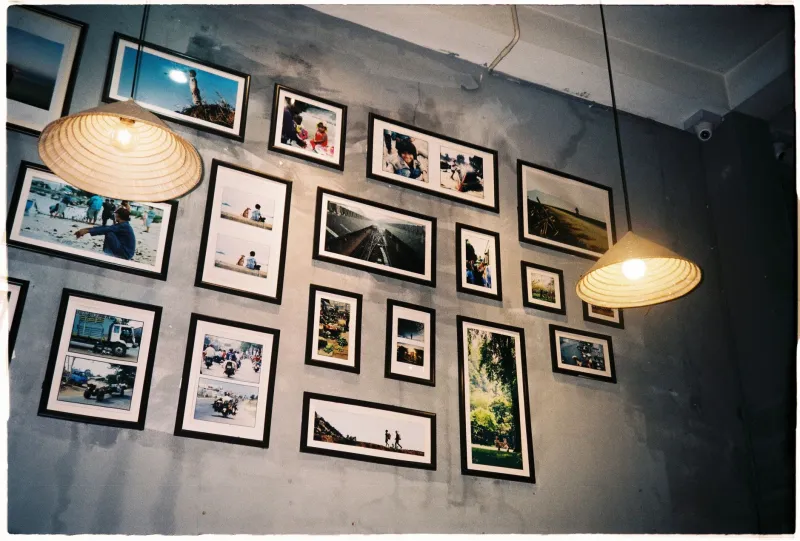
A gallery wall done well looks effortless. Done poorly, it looks like a yard sale. The difference is usually in a few key decisions made before anything goes up.
Start on the floor. Lay out your frames and prints on the ground before committing to any holes in the wall. Shuffle things around until the arrangement feels balanced — not necessarily symmetrical, but visually weighted. Step back and look at it from a distance.
Vary the sizes and orientations. A gallery wall made entirely of same-sized frames in the same orientation reads as flat and corporate. Mix it up — a large anchor piece, a few mediums, a couple of smalls. Landscape and portrait orientations together create visual rhythm.
Give pieces room to breathe. Overcrowding is one of the most common mistakes. Aim for roughly 2-3 inches between frames. More than that and the grouping starts to feel scattered; less and it gets claustrophobic.
Create a unifying element. This doesn't mean everything has to match — but having one thread that runs through the grouping (a consistent frame color, a shared color palette in the artwork, a similar subject matter) helps the wall feel curated rather than random.
Lighting Changes Everything
You can have the most beautifully composed gallery wall in the world, and bad lighting will kill it. Art deserves to be seen properly.
Picture lights — those small fixtures that mount directly above a frame — are a classic solution and genuinely effective. LED versions are widely available at home improvement stores and won't generate heat that damages paper-based works.
If you're working with existing overhead lighting, look at where your light actually falls. Warm-toned bulbs (around 2700-3000K) tend to be flattering for most artwork. Avoid positioning art directly across from a bright window if you can — glare on glass frames is the enemy of a good viewing experience.
For rooms where you want more flexibility, adjustable track lighting gives you the ability to direct light exactly where it needs to go as your collection grows and changes.
Framing: Where to Spend and Where to Save
Not everything needs a custom frame. Simple black or white frames from IKEA (the RIBBA line in particular) are a genuinely good option for prints and smaller works. They're clean, consistent, and affordable enough that you can buy several at once.
Where it's worth investing in quality framing: original works on paper, photographs you care about, and anything with sentimental or financial value. A good frame protects the work and elevates it. Look for acid-free matting and UV-protective glass, especially for works that will be displayed in a sunny room.
Local frame shops are often more affordable than people expect, and they can give you options a big-box store simply doesn't offer. They're also a great place to meet people who are deeply embedded in the local art scene.
Finding and Supporting Emerging Local Artists
Your city has artists. A lot of them. And many of them are making extraordinary work that you've never seen because it's not in a gallery on the main drag.
Start at local art fairs and open studio events — these happen in almost every major US city and are genuinely fun ways to spend a weekend morning. Follow your local arts council on social media; they typically spotlight regional artists regularly. Check out MFA thesis shows at nearby universities, where you can often buy directly from the artists at very accessible price points.
When you buy from an emerging artist, you're doing something that matters beyond the transaction. You're helping a creative person sustain their practice. You're voting for a world where artists can keep making things. And you're getting something for your wall that carries a real story.
That's a pretty good deal for everyone involved.