Five Minutes a Day: The Brain Science That Makes Daily Sketching More Powerful Than You Think
Most artists have had the same conversation with themselves at least once. You promise a full weekend in the studio. Life happens. The weekend disappears. You end up feeling guilty instead of creative, and the gap between who you are and who you want to be as an artist quietly widens.
Here's the thing nobody tells you at the start: the gap doesn't close with bigger blocks of time. It closes with smaller, more consistent ones.
That might feel like a consolation prize. It isn't. There's serious neuroscience behind why five focused minutes of daily sketching can do more for your creative development than an occasional six-hour session — and a growing community of American artists who've proven it in their own studios, kitchens, and lunch breaks.
What's Actually Happening in Your Brain When You Draw Every Day
Your brain is not a fixed thing. It's a living system that physically reorganizes itself based on what you repeatedly do — a property scientists call neuroplasticity. Every time you pick up a pencil and draw, you're activating a network of neural pathways connecting your visual cortex, motor cortex, and the parts of your brain responsible for spatial reasoning and problem-solving.
Do that once, and the connection is faint. Do it every day for 30 days, and something measurable happens: those pathways get thicker, faster, and more automatic. Researchers studying skill acquisition have found that frequency of practice matters more than duration when it comes to building durable neural habits. Translation? Drawing for five minutes daily beats drawing for two hours on Saturdays.
There's also the matter of what psychologists call "attentional training." Regular sketching — even casual, observational doodling — trains your brain to slow down and actually look. Artists who sketch daily report noticing light, shadow, proportion, and texture in everyday environments in ways they simply didn't before. That's not metaphor. That's a documented shift in how the visual processing centers of the brain allocate attention.
Real Artists, Real Results
Tamara Evens, a graphic designer based in Portland, Oregon, started what she calls her "one drawing rule" after hitting a creative wall in 2022. No pressure, no themes, no finished pieces required — just one sketch per day, no matter how rough. She kept a cheap spiral notebook on her kitchen counter.
"The first week felt pointless," she admits. "I was drawing coffee cups and my dog. But around day twelve, something shifted. I started seeing my design work differently. I was solving layout problems faster, almost intuitively."
By the end of her first 30 days, Tamara hadn't produced a single gallery-worthy piece. What she had produced was a rewired creative reflex — a habit of observation that started bleeding into every part of her work.
In Atlanta, illustrator Marcus Webb had a similar experience after years of treating his personal art practice as something he'd get to "when things slowed down." He committed to sketching every morning before opening his email, even if only for five minutes.
"It sounds almost embarrassingly small," Marcus says. "But those five minutes started my brain in a completely different mode for the rest of the day. I stopped feeling like creativity was something I had to chase. It was just already running."
Your 30-Day Framework: A Practical Reset
You don't need a plan that's complicated to follow. In fact, complexity is the enemy of habit. Here's a simple structure that builds on itself over four weeks.
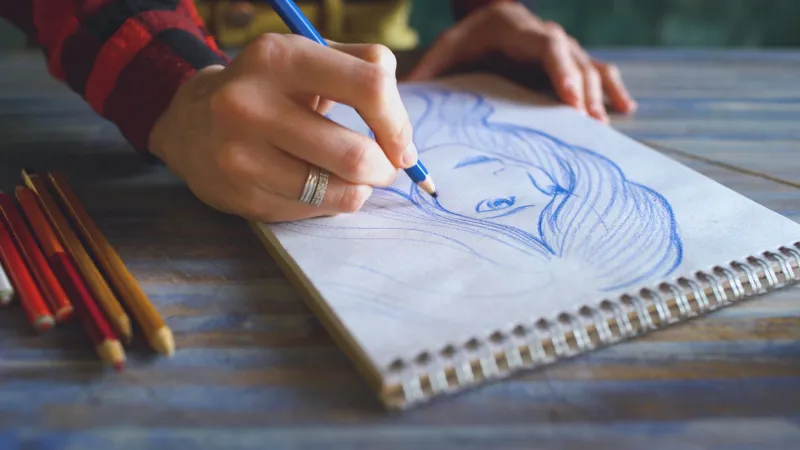
Week One: Just Show Up (Days 1–7) The only rule is contact. Pick up something that makes a mark — pencil, pen, charcoal, whatever's closest — and draw for at least five minutes. Draw what's in front of you. Don't evaluate it. The goal is to make showing up feel easy and low-stakes. Keep your sketchbook somewhere visible, not tucked in a bag.
Week Two: Add One Constraint (Days 8–14) Constraints are creativity's best friend. This week, pick a single loose theme for each day — hands, shadows, windows, food, strangers on your commute. A constraint focuses your attention without adding pressure. You're still just sketching. You're just sketching at something specific.
Week Three: Lengthen One Session (Days 15–21) Choose one day this week — just one — to extend your session to 20 or 30 minutes. Don't force it on other days. Notice what happens when you have more time after two weeks of daily warm-up. Most artists find this week is when things start feeling genuinely exciting rather than obligatory.
Week Four: Reflect and Repeat (Days 22–30) Flip back through your sketchbook. Don't judge the drawings. Look for patterns — what subjects kept pulling you in? Where did your hand feel most confident? What do you want to explore next? Use the final days to sketch with those observations in mind. You're not finishing the habit. You're understanding it well enough to keep it.
The Myth of the Marathon Session
Western culture has a complicated relationship with productivity. We tend to believe that more time equals more output, and that output is the point. But creative development doesn't work that way, and the artists who internalize that earliest tend to grow the fastest.
Consider what a daily practice actually gives you that a weekend binge doesn't: continuity. When you pick up where you left off yesterday — even if "where you left off" was a scribbled thumbnail — your brain re-enters a state of creative engagement much faster than if you're starting cold after a week away. That continuity compounds. Over 30 days, you accumulate not just drawings but a kind of creative momentum that starts to feel self-sustaining.
You also accumulate evidence. A sketchbook filled across a month is proof — to yourself, before anyone else — that you are someone who makes art regularly. Identity follows behavior. The more consistently you act like an artist, the more naturally you'll think like one.
Starting Tomorrow (Not Someday)
You don't need a new sketchbook, a better pen, or a cleared schedule. You need a surface and something to mark it with, and about five minutes you can protect from interruption. That's genuinely the whole entry requirement.
If you want a community to keep you accountable, Art350's creative forums are full of artists at every level doing exactly this — sharing daily sketches, asking questions, and cheering each other on through the awkward early weeks.
The 30-day reset isn't about becoming a different artist by the end of the month. It's about discovering that the artist you want to be is already in there, just waiting for a consistent invitation to show up.
Give them five minutes tomorrow. Then the day after. The brain will handle the rest.