Your Phone Is Already a Gallery: How American Artists Are Building Real Careers Without Ever Touching a White Wall
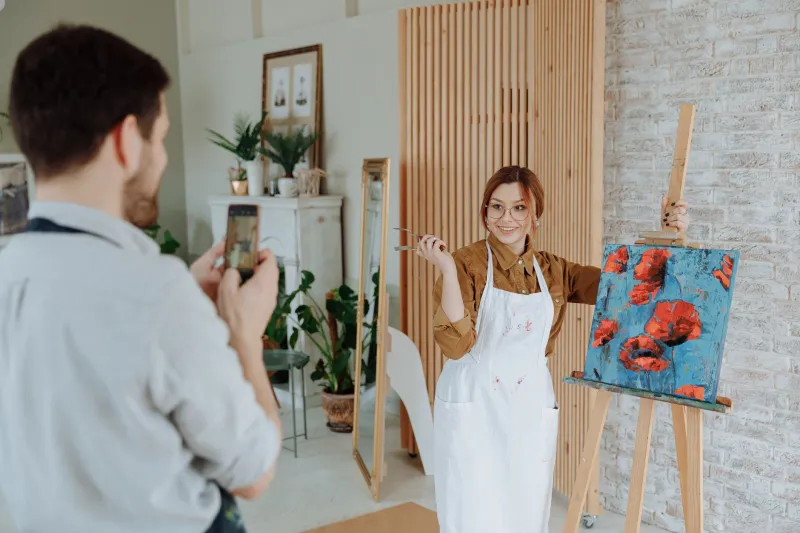
Let's be honest about something the traditional art world doesn't love to admit: most working artists in America will never get a solo show at a Chelsea gallery. That's not a criticism — it's just math. There are millions of talented, serious, commercially viable artists in this country, and there are only so many gallery walls to go around.
But here's the thing. The walls moved.
In 2025, the most visited "galleries" in America aren't physical spaces. They're Instagram grids, TikTok feeds, and Pinterest boards — and the artists who figured that out early are quietly building careers that would have been impossible a decade ago. No gatekeepers. No 50% commission. No waiting three years for a callback.
Just you, your work, and a device you already own.
Why the Smartphone Stopped Being a Compromise
There's a lingering snobbery in some corners of the art world about phone photography — the idea that shooting your work on a smartphone is somehow less serious than hiring a professional photographer or using a DSLR. That attitude is fading fast, and for good reason.
Modern smartphone cameras — particularly the current generation of iPhones and Android flagships — are capturing images with enough resolution and color accuracy to satisfy most print-on-demand services, licensing platforms, and editorial clients. More importantly, they're capturing images that look native to the platforms where most art discovery actually happens today.
When someone finds your painting through a Reels video or a TikTok process clip, they're not evaluating it through the same lens as a museum curator. They're connecting with it emotionally, in real time, on a 6-inch screen. Authenticity outperforms polish in that context almost every single time.
Artists who understand this aren't cutting corners. They're speaking the right language for the right room.
Shooting Your Work With a Phone (And Making It Look Great)
You don't need a lighting rig or a photography degree to document your work well. You need a few consistent habits.
Natural light is your best friend. Position your work near a large north-facing window if you can — the light is even and doesn't cast harsh shadows. Avoid direct sunlight, which blows out highlights and distorts color. Overcast days are genuinely ideal for photographing paintings and illustrations.
Get your phone parallel to the surface. One of the most common mistakes artists make is shooting at an angle, which creates keystoning — that trapezoidal distortion where your square canvas looks like a trapezoid. Mount your phone on a small tripod or prop it so it's perfectly flat relative to your work before you shoot.
Use your phone's grid overlay. Most camera apps have a grid option in settings. Turn it on and use it to align your work precisely within the frame. A slightly crooked shot of a beautiful painting will always look unprofessional.
Shoot in the highest quality setting available. Edit afterward — don't try to compensate for a bad shot in post. Apps like Lightroom Mobile (free version works fine) let you correct white balance and exposure without distorting your colors.
Record your process. A 30-second time-lapse of a painting in progress almost always outperforms a static finished shot in terms of reach and engagement. People are fascinated by the act of making — use that.
Which Platforms Are Actually Working for Artists Right Now
Not every platform delivers equal results for visual artists, and the landscape shifts constantly. Here's where the real traction is happening in 2025.
Instagram remains the primary portfolio platform for most visual artists, but static posts alone aren't enough anymore. Reels — especially process videos and studio tours — are getting dramatically more reach than grid posts. Think of your grid as your gallery wall and Reels as your opening night.
TikTok has become a genuine discovery engine for artists at every level. Short process videos, "how I made this" breakdowns, and even pricing transparency content (yes, showing what your work costs and why) are generating real sales conversations. Artists report DMs from collectors who found them through TikTok and had never engaged with art on Instagram at all.
Pinterest is quietly one of the most underrated platforms for artists selling prints or originals online. Content has a much longer shelf life than on other platforms — a single well-tagged pin can drive traffic to your shop for years. If you're selling through Etsy, Society6, or your own site, Pinterest should be part of your strategy.
YouTube rewards artists willing to go longer. Studio vlogs, technique tutorials, and "day in the life" content build deep audience loyalty and drive consistent traffic. It's more work than a 15-second clip, but the community that forms around YouTube channels tends to be more committed — and more likely to buy.
Real Artists, Real Results
The stories coming out of this shift aren't outliers anymore. Across the US, artists are reporting meaningful career milestones that came directly from mobile-first platforms.
A watercolor artist in Portland, Oregon built a following of over 80,000 people on TikTok by posting honest, unfiltered videos of her painting process — including the failures. She now sells out limited print runs within hours of announcing them, entirely through her link-in-bio.
A muralist in Atlanta started documenting his large-scale public work through Instagram Reels and landed two corporate commissions from businesses that found him through location tags on his posts. Neither client had any prior connection to the traditional gallery world.
A ceramicist in rural New Mexico who had zero access to major art markets started selling her work through a combination of Instagram and a Shopify store. Her first year of online sales exceeded what she'd made in five years of local craft fairs.
None of these artists needed a gallery. They needed consistency, a clear visual identity, and the willingness to show up regularly on the platforms where their future collectors were already spending time.
The Mindset Shift That Makes It All Work
Here's the part that doesn't get talked about enough: using your phone as a gallery isn't just a tactical decision. It's a philosophical one.
Traditional gallery systems were built around scarcity and access control — the idea that art's value was partly defined by how difficult it was to encounter. The mobile-first model inverts that entirely. Visibility creates value. Transparency builds trust. Consistency earns loyalty.
That doesn't mean giving everything away or devaluing your work. It means understanding that the relationship between an artist and a collector often starts long before any money changes hands — and that relationship now begins on a phone screen, not in a white-walled room.
Your smartphone isn't a lesser version of a gallery. For most American artists in 2025, it's a better one.
Start shooting.